
The mechanics of off-page search engine optimization are undergoing a massive transformation.
The strategies that worked years ago—such as buying low-tier sponsored posts, cold-emailing thousands of blogs for generic guest posts, or dropping keyword-rich links into arbitrary web directories—are no longer effective. In today’s search landscape, search engine algorithms and generative AI models prioritize trust, verified expertise, and contextual editorial relevance above pure link quantity.
Industry research reflects this dramatic shift in how audiences and AI systems consume information:
- Declining Organic Search Traffic: According to the Reuters Institute Digital News Report, social platforms, video networks, and zero-click AI summaries are rapidly displacing traditional publisher direct visits, making platformization and external brand mentions essential for digital visibility.
- Journalist Reliance on Data PR: Insights from Cision’s State of the Media Report reveal that 66% of journalists rely directly on PR-provided content—such as data studies, press releases, media kits, and expert access—as their primary source for story ideas amidst shrinking newsroom resources.
- Impact of Original Visuals: Data compiled in HubSpot’s Visual Marketing Trends shows that custom graphics, charts, and infographics receive up to 94% more views and citations than text-only posts, driving consistent inbound editorial references.
The answer to navigating this shift lies in the evolution of Digital PR.
In this guide, I examine how Digital PR link building and media mentions are adapting to AI-driven search, dive deep into the technical shift behind modern brand citations, and share the exact frameworks and research-backed workflows I use to build long-term authority.
What is Digital PR Link Building? (And Why It Supersedes Traditional Outreach)
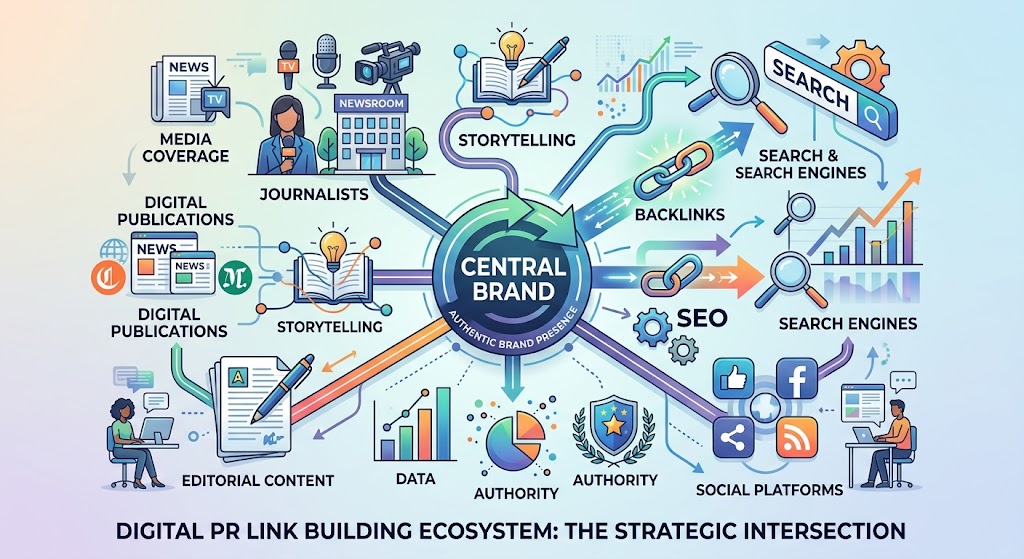
- Traditional PR focuses primarily on brand awareness, print features, and media impressions. Traditional SEO link building, on the other hand, often fixates solely on metric scores (like DA or DR) and anchor text placement.
- Digital PR combines the best of both worlds. It brings together media relations, compelling storytelling and SEO to create meaningful online visibility. Digital PR campaign strategies can help brands turn valuable content and stories into media coverage, mentions and backlinks.
- I define Digital PR as the art of creating newsworthy, data-backed, or creative stories that journalists, editors, and bloggers want to cite as a primary source. When an editor links to your website in a news piece or feature article, that hyperlink can contribute to your site’s authority and search visibility. My guide to backlink strategies for SEO and branding explores this relationship in greater detail.
Digital PR bridges both worlds. It brings together media relations, data journalism, creative storytelling, visual design, and search engine optimization to build authentic, scalable online visibility.
Instead of chasing manipulative or paid link tactics, Digital PR focuses on creating newsworthy, data-backed, or highly creative content assets that journalists, digital editors, and AI language models naturally want to cite as a primary source.
The Technical Shift: From Simple Hyperlinks to AI Entity Citations
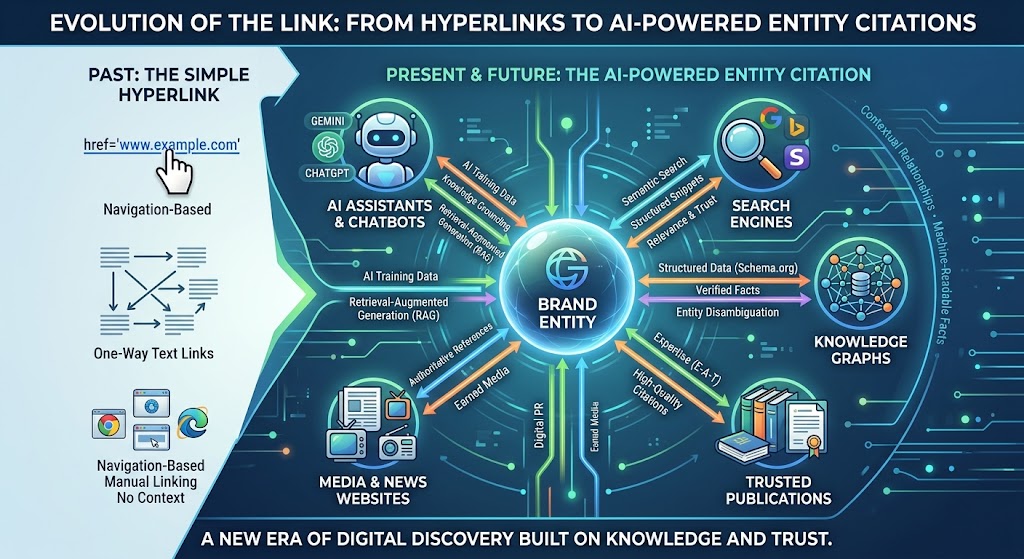
Search engines and AI discovery platforms (such as Google’s AI Overviews, Perplexity, and ChatGPT) do not just crawl and count hyperlinks; they parse complete linguistic context and entity relationships.
Academic and technical research continuously demonstrates how Large Language Models (LLMs) evaluate web content and brand authority:
- Princeton University’s GEO Research: Landmark academic research on Generative Engine Optimization (GEO) published on arXiv highlights that generative AI search engines demonstrate a systematic bias toward earned media and authoritative third-party citations over plain self-owned brand content. Adding clear quotes, verified sources, and authoritative statistics can increase a page’s citation likelihood in AI answers by up to 30–40%.
- Impact of Technical Schema & Entity Markup: A large-scale industry study by Milestone Research analyzing over 4,500 domain profiles revealed that implementing structured JSON-LD entity data boosts machine readability, driving up to a 40% increase in rich-result impressions and AI source extractions.
- Shift to Knowledge Graph Relationships: Technical SEO analysis from Search Engine Land explains that generative search algorithms rely on Retrieval-Augmented Generation (RAG) to verify entity co-occurrences and extract answers directly from trusted primary sources.
When a national news outlet, industry publication, or niche magazine references your brand, campaign, or research, three critical things happen behind the scenes:
- Entity Context & Co-Occurrence: Search engine algorithms scan the text surrounding a media mention. When your brand name consistently appears alongside specific industry terms (e.g., “digital marketing,” “PR strategies,” or “content creation”), search engine knowledge graphs link your brand entity directly to those core topics. To learn more about claiming and optimizing these brand associations, see my guide on building a Google Knowledge Panel.
- AI Model Extraction: Large Language Models gather information from high-authority digital publications. Earning consistent contextual mentions across niche media domains directly boosts your citation frequency in AI-driven summaries.
- Multi-Layered Authority Signals: Natural editorial mentions—whether they include a live hyperlink or an unlinked brand reference—pass semantic trust that paid link networks cannot imitate.
To explore how these core content structures interact with search engine crawlers and indexing frameworks, take a look at my guide on creating a blog post Google will send many readers to. Furthermore, to understand how generative search engines answer complex user queries, see this analysis on Digital PR in the AI Era.
Core Digital PR Frameworks for Earning Mentions & Citations
When planning a campaign, these modern Digital PR methodologies offer structured, repeatable ways to earn contextual editorial links, citations, and broad media coverage:
1. Data-Driven PR & Reactive Research
Journalists, newsrooms, and online writers operate on fast-paced editorial schedules and constantly need factual evidence to back up their claims. In fact, research from Cision’s State of the Media Report highlights that 66% of journalists rely directly on PR content for story leads, while 49% cite shrinking budgets and resource constraints as their top operational obstacle, making ready-to-use primary data essential for news coverage.
- Execution Workflow: Gather internal platform analytics, conduct targeted industry surveys, or analyze public datasets (such as Google Search trends, Office for National Statistics data, or industry regulatory reports). Package these findings into a concise press pitch with clear key statistics.
- AI & Search Value: Raw numbers, statistics, and survey findings are heavily cited by generative AI tools when answering factual queries, giving your platform lasting search presence.
2. Newsjacking & Reactive PR
Newsjacking involves monitoring real-time industry news and jumping into trending conversations with immediate expert commentary, analysis, or predictions.
- Execution Workflow: Set real-time tracking alerts for key industry sector topics across tech, digital marketing, retail, or economic trends. When a breaking story occurs, draft a succinct, 150-to-200-word expert quote or reaction statement within two hours and pitch it directly to beat journalists.
- Why It Works: Journalists on tight deadlines need immediate expert insights to complete breaking news pieces, providing a reliable channel for high-relevance editorial mentions. To see how fast news cycles intersect with niche content distribution, learn about my work in micro blogging and content strategy.
3. Thought Leadership & SEO Press Releases
Press releases are no longer corporate broadcast tools meant solely for stock tickers or archive sites. Modern press releases must function as rich, story-driven editorial resources designed for human readers and search engines alike.
- Execution Workflow: Structure releases around a real-world industry problem, offer actionable expert solutions, embed media assets, and direct readers to a comprehensive research hub on your domain. For a deep dive into structuring these assets, review my comparison guide on SEO press releases vs traditional press releases.
4. Expert Roundups & Linkable Content Assets
Creating hero content assets on your site gives content creators, bloggers, and reporters a compelling reason to link back or reference your site as a foundational resource.
- Execution Workflow: Produce detailed industry benchmarks, toolkit comparisons, or multi-perspective expert roundups on emerging trends.
- Resource: You can explore my work across diverse content frameworks in my Author Portfolio & Blog to see how structured editorial guides operate in practice.
5. Visual PR & Data Graphics
Visual elements significantly improve media pickup rates. Industry benchmark analysis from HubSpot’s Visual Marketing Trends indicates that including custom infographics and original visual data graphics can increase inbound editorial links by up to 178% and receive 94% more views than text-only posts.
- Execution Workflow: Supply publications with downloadable, high-resolution visual assets accompanied by clear embedding codes and source attribution guidelines.
- Important Note: Always ensure any visual elements follow proper usage rights. Learn more in my detailed guide on blog images and legal usage for content creators.
6. Experiential Brand Collaborations & Media Partnerships
One of the most powerful—yet underutilized—ways to generate high-authority Digital PR backlinks is through multi-brand experiential campaigns and creator collaborations. By partnering with established brands, PR agencies, and digital publications, you create rich, news-worthy stories that attract organic media coverage across multiple domains simultaneously.
- How I execute this: I design collaborative campaigns that unite creators, media titles, and experiences. For instance, I spearheaded an experiential campaign connecting major attractions and media outlets, detailed in my Planetarium GO & Zip World Brand Collaboration case study. Similarly, I explored creator-led storytelling strategies in my ClickDo Lifestyle Creator Brand Collaboration Case Study. These real-world partnerships give journalists a tangible, exciting story angle to cover, generating natural editorial links across multiple publications.
Step-by-Step: Launching Your Campaign in 4 Phases
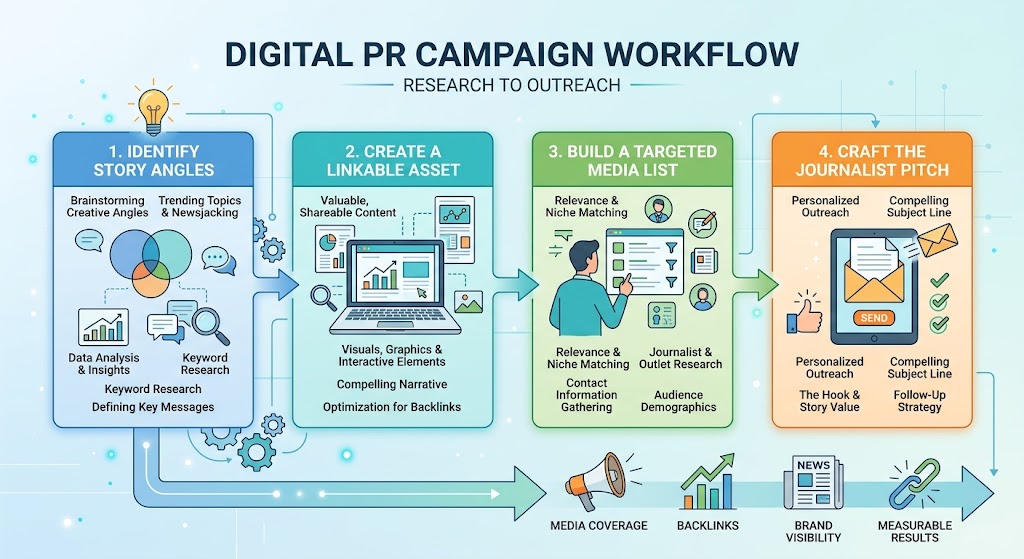
Phase 1: Identify Your Angles: Story Ideation.
Brainstorm story hooks that connect your brand’s expertise to current industry trends, cultural moments, or interesting data points. Ask yourself: “Why would a reader or editor care about this today?”
Phase 2: Create the Linkable Asset: On-Site Hub.
Publish a dedicated hub page or blog post on your website containing the full data set, methodology, or expert guide. This page serves as the target destination for journalists to link back to.
Phase 3: Build a Targeted Media List: Outreach List.
Use PR tools like Muck Rack, Prowly, or targeted Google site searches to find journalists and editors who actively write about your specific niche.
Phase 4: Craft a Pitch That Gets Opened: Journalist Pitch.
Keep your outreach short, direct, and value-focused. State the main takeaway in the first two sentences, provide bulleted insights, and include a direct link to your resource.
Final Thoughts for Modern Digital Strategies
Digital PR is not a short-term link trick or a shortcut for buying cheap backlink packages. When executed consistently, it serves as a sustainable engine for building brand trust, media relationships, search engine authority, and long-term digital citations.
As search tools continue incorporating AI-driven summary answers, the brands that succeed will be those that prioritize:
- Authentic expert insight and transparent data sources
- Strategic, multi-brand experiential storytelling
- Comprehensive, original content assets that serve as definitive primary sources
Whether launching your first campaign or refining an existing outreach framework, focus on creating content and stories that are genuinely valuable, informative, and context-rich.
If you would like to discuss a tailored campaign for your brand, feel free to reach out directly at info@manuelawillbold.com or through my contact page to get started.