
Author name: rakshana

digital-pr-link-building-strategies
digital marketing, digital PR

Digital PR Link Building: How Getting Backlinks at Scale Is Changing

The mechanics of off-page search engine optimization are undergoing a massive transformation.  The strategies that worked years ago—such as buying low-tier sponsored posts, cold-emailing thousands of blogs for generic guest posts, or dropping keyword-rich links into arbitrary web directories—are no longer effective. In today’s search landscape, search engine algorithms and generative AI models prioritize trust, verified expertise, and contextual editorial relevance above pure link quantity. Industry research reflects this dramatic shift in how audiences and AI systems consume information: Declining Organic Search Traffic: According to the Reuters Institute Digital News Report, social platforms, video networks, and zero-click AI summaries are rapidly displacing traditional publisher direct visits, making platformization and external brand mentions essential for digital visibility. Journalist Reliance on Data PR: Insights from Cision’s State of the Media Report reveal that 66% of journalists rely directly on PR-provided content—such as data studies, press releases, media kits, and expert access—as their primary source for story ideas amidst shrinking newsroom resources. Impact of Original Visuals: Data compiled in HubSpot’s Visual Marketing Trends shows that custom graphics, charts, and infographics receive up to 94% more views and citations than text-only posts, driving consistent inbound editorial references. The answer to navigating this shift lies in the evolution of Digital PR. In this guide, I examine how Digital PR link building and media mentions are adapting to AI-driven search, dive deep into the technical shift behind modern brand citations, and share the exact frameworks and research-backed workflows I use to build long-term authority. What is Digital PR Link Building? (And Why It Supersedes Traditional Outreach) Traditional PR focuses primarily on brand awareness, print features, and media impressions. Traditional SEO link building, on the other hand, often fixates solely on metric scores (like DA or DR) and anchor text placement. Digital PR combines the best of both worlds. It brings together media relations, compelling storytelling and SEO to create meaningful online visibility. Digital PR campaign strategies can help brands turn valuable content and stories into media coverage, mentions and backlinks. I define Digital PR as the art of creating newsworthy, data-backed, or creative stories that journalists, editors, and bloggers want to cite as a primary source. When an editor links to your website in a news piece or feature article, that hyperlink can contribute to your site’s authority and search visibility. My guide to backlink strategies for SEO and branding explores this relationship in greater detail. Digital PR bridges both worlds. It brings together media relations, data journalism, creative storytelling, visual design, and search engine optimization to build authentic, scalable online visibility. Instead of chasing manipulative or paid link tactics, Digital PR focuses on creating newsworthy, data-backed, or highly creative content assets that journalists, digital editors, and AI language models naturally want to cite as a primary source. The Technical Shift: From Simple Hyperlinks to AI Entity Citations Search engines and AI discovery platforms (such as Google’s AI Overviews, Perplexity, and ChatGPT) do not just crawl and count hyperlinks; they parse complete linguistic context and entity relationships. Academic and technical research continuously demonstrates how Large Language Models (LLMs) evaluate web content and brand authority: Princeton University’s GEO Research: Landmark academic research on Generative Engine Optimization (GEO) published on arXiv highlights that generative AI search engines demonstrate a systematic bias toward earned media and authoritative third-party citations over plain self-owned brand content. Adding clear quotes, verified sources, and authoritative statistics can increase a page’s citation likelihood in AI answers by up to 30–40%. Impact of Technical Schema & Entity Markup: A large-scale industry study by Milestone Research analyzing over 4,500 domain profiles revealed that implementing structured JSON-LD entity data boosts machine readability, driving up to a 40% increase in rich-result impressions and AI source extractions. Shift to Knowledge Graph Relationships: Technical SEO analysis from Search Engine Land explains that generative search algorithms rely on Retrieval-Augmented Generation (RAG) to verify entity co-occurrences and extract answers directly from trusted primary sources. When a national news outlet, industry publication, or niche magazine references your brand, campaign, or research, three critical things happen behind the scenes: Entity Context & Co-Occurrence: Search engine algorithms scan the text surrounding a media mention. When your brand name consistently appears alongside specific industry terms (e.g., “digital marketing,” “PR strategies,” or “content creation”), search engine knowledge graphs link your brand entity directly to those core topics. To learn more about claiming and optimizing these brand associations, see my guide on building a Google Knowledge Panel. AI Model Extraction: Large Language Models gather information from high-authority digital publications. Earning consistent contextual mentions across niche media domains directly boosts your citation frequency in AI-driven summaries. Multi-Layered Authority Signals: Natural editorial mentions—whether they include a live hyperlink or an unlinked brand reference—pass semantic trust that paid link networks cannot imitate. To explore how these core content structures interact with search engine crawlers and indexing frameworks, take a look at my guide on creating a blog post Google will send many readers to. Furthermore, to understand how generative search engines answer complex user queries, see this analysis on Digital PR in the AI Era. Core Digital PR Frameworks for Earning Mentions & Citations When planning a campaign, these modern Digital PR methodologies offer structured, repeatable ways to earn contextual editorial links, citations, and broad media coverage: 1. Data-Driven PR & Reactive Research Journalists, newsrooms, and online writers operate on fast-paced editorial schedules and constantly need factual evidence to back up their claims. In fact, research from Cision’s State of the Media Report highlights that 66% of journalists rely directly on PR content for story leads, while 49% cite shrinking budgets and resource constraints as their top operational obstacle, making ready-to-use primary data essential for news coverage. Execution Workflow: Gather internal platform analytics, conduct targeted industry surveys, or analyze public datasets (such as Google Search trends, Office for National Statistics data, or industry regulatory reports). Package these findings into a concise press pitch with clear key statistics. AI & Search Value: Raw numbers, statistics, and survey findings are heavily cited

digital-marketing-tool-cost-cutter-guide
digital marketing

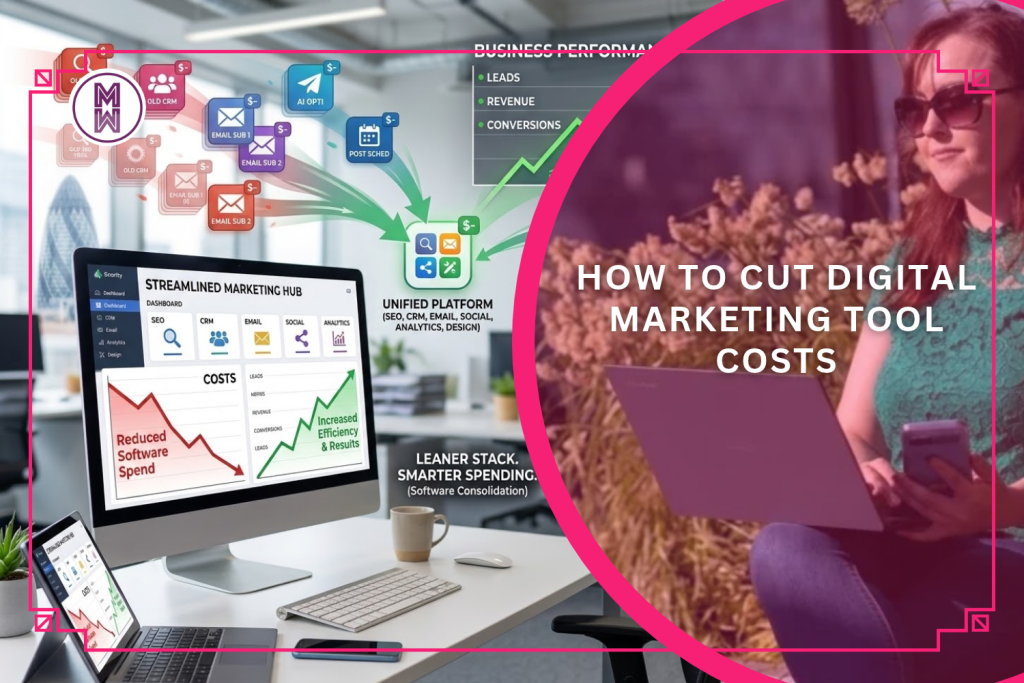
How to Cut Digital Marketing Tool Costs

Digital marketing software has a habit of getting expensive quietly. One SEO tool becomes two. The email platform moves up a pricing tier. Somebody adds an AI writing subscription, another person needs a design tool, and before long the business is paying for a dozen different platforms every month. None of those individual charges necessarily looks excessive. The problem is the stack as a whole. For freelancers, marketers and small businesses, the cost of digital marketing tools can easily run into hundreds or thousands of dollars each month. And a surprising amount of that spend is often unnecessary. Cutting those costs does not mean replacing good software with inferior free alternatives. It usually means being more deliberate about what you pay for, how you pay for it, and whether the tools in your marketing stack are still earning their place. Start With a Proper Audit of Your Marketing Tools The first step is simple: list everything you are paying for. That means more than checking the obvious platforms. Look through company cards, PayPal subscriptions, app stores, expense claims and invoices. A typical digital marketing toolkit might include: SEO and keyword research software Email marketing platforms CRM software Social media scheduling tools Graphic design software AI writing and research tools Analytics platforms Landing page builders Heatmapping and CRO tools Stock photography or video subscriptions Webinar platforms Automation software Once everything is in one place, add the monthly or annual cost next to each tool. Then add one more column: when did we last use it? That question often reveals more than the price itself. A $40 subscription that has not been used for four months is more expensive than a $200 tool that saves the team several hours every week. Look for Tools Doing the Same Job Overlap is one of the biggest sources of wasted marketing spend. Marketing software has expanded dramatically over the past few years, and many platforms now include features that used to require separate products. Your CRM may include email automation. Your SEO platform may now include content optimisation. Your email marketing software may include landing pages, forms and basic customer relationship management. Your project management tool may include forms, approvals and content calendars. Yet businesses often continue paying for the older standalone products as well. This is particularly common when different people purchase software independently. Before renewing a tool, ask: Do we already pay for another platform that can do this? The replacement does not need to be technically identical. It simply needs to be good enough for the way your business actually uses the feature. There is little point paying $50 a month for an advanced social scheduling platform if you only schedule eight posts a week. Be More Ruthless With SEO Software SEO tools are among the easiest marketing subscriptions to accumulate. You might use one platform for keyword research, another for backlinks, another for technical audits and another for content optimisation. That can make sense for an agency managing dozens of websites. It often makes less sense for a small business running one or two sites. Think about how frequently you genuinely need each tool. Keyword research, for example, is not necessarily something every business needs to perform every day. You may be able to subscribe for a month, complete a large batch of research, export the data you need and then cancel until the next research cycle. The same applies to certain backlink and competitor research tools. Not every marketing application needs to become a permanent monthly expense. Check Your Email Marketing Tier Email platforms are another common source of creeping costs because pricing often increases as your contact list grows. The obvious problem is that businesses frequently pay for contacts they no longer need. Old leads, invalid email addresses, people who have not opened anything in years and duplicate contacts can all push an account into a more expensive pricing tier. Before upgrading your email marketing plan, clean the database. Remove or suppress contacts that provide no realistic value. Check whether your current platform charges for inactive contacts and whether changing how they are stored can reduce the bill. It is also worth reviewing competitors periodically. Email marketing is a competitive category, and businesses sometimes remain on an expensive legacy plan simply because migrating feels inconvenient. That inconvenience may be costing hundreds or thousands of dollars a year. Stop Treating Every AI Tool as Essential AI software deserves its own audit. The explosion of generative AI has created a new kind of subscription sprawl. Marketers can now pay separately for writing, research, image generation, video creation, transcription, meeting summaries, SEO content, presentations and automation. The problem is that the functionality overlaps constantly. A feature that required a dedicated tool twelve months ago may now be included in software you already use. This is one area where it makes sense to review subscriptions more frequently than once a year. Every few months, ask: Is anybody still using this? Does another tool now perform the same function? Are we paying for a premium tier when the basic plan would work? Are multiple team members paying separately for similar AI tools? The AI market changes too quickly to assume that last year’s software stack is still the best one. Pay Annually Only When the Tool Has Proved Itself Annual billing can be one of the easiest ways to reduce software subscription costs, but only when the decision is made carefully. Many marketing platforms offer meaningful discounts for paying for a year upfront. For a tool you have used every working day for the past three years, that can be an easy saving. For a new product you started testing last Tuesday, it is a different story. The annual discount means very little if you stop using the software after two months. A sensible rule is: Test monthly, commit annually. Once a tool has become part of your normal workflow and you are reasonably confident it will stay there, compare the annual price with

digital marketing

Traffic Quality vs. Quantity: Why Less Traffic Can Actually Mean More Revenue

A traffic graph can climb while revenue stays stubbornly flat. It feels like progress because the number is visible, immediate, and easy to report. Yet sessions do not pay invoices. Customers do. The difference becomes clear when you look at visitor value rather than visitor volume. In a 2012 retail study based on 33 billion visits, Adobe Digital Index (The ROI from Marketing to Existing Online Customers. Adobe Systems Incorporated, PDF archived) found that returning and repeat purchasers made up only 8 per cent of US visitors but generated more than 40 per cent of revenue. The study is dated and specific to retail. However, the imbalance is still a useful warning: a small, valuable audience can contribute far more than a large crowd of casual browsers. The modern benchmark is not particularly generous either. Unbounce’s Conversion Benchmark Report analysed more than 41,000 landing pages, 464 million visits, and 57 million conversions. It found a median landing-page conversion rate of 6.6 per cent across industries, with industry medians ranging from 3.8 to 12.3 per cent. That means most visits do not become the action being measured, even on dedicated campaign pages. Traffic quality is therefore not an abstract marketing idea. It is the relationship between who arrives, what they need, how well your page matches that need, and what commercial value follows. Once you measure that relationship properly, a smaller audience can be the healthier result. Why High-Intent Visitors Convert More Often Picture two shops selling the same specialist product. One sits in a busy railway station, while the other has a small stand at an industry exhibition. The station shop sees far more people, but most are on their way somewhere else. The exhibition stand sees fewer people, yet many have arrived specifically to compare products like yours. High-intent visitors resemble the exhibition audience. They recognise a problem, are actively considering a solution, and have a credible reason to act soon. A visitor searching for a particular product model, checking delivery to their postcode, comparing two service packages, or looking for an available local supplier is much closer to a decision than someone reading a broad introductory article. Intent is not the same as a keyword label, of course. A commercial-sounding search can still come from a student, competitor, or curious researcher. Equally, an informational visit can become valuable later. The point is to treat intent as a testable signal rather than assuming every click has equal potential. Pro Marketer Tips:  Start by mapping each important landing page to the job a visitor is trying to complete. A product page should help someone assess suitability and buy. A service page should explain the outcome, scope, proof, process, and next step. A comparison page should make the trade-offs clear. If the page solves a different job from the advert, email, referral, or search result that brought the visitor there, volume will not rescue it. You can then group acquisition activity by likely intent. Brand searches, product-specific campaigns, remarketing audiences, partner referrals, and well-matched email clicks often deserve separate analysis from broad social reach or general-interest content. Do not declare one group better in advance. Compare what people actually do after arriving. Look for a sequence of useful behaviours rather than a single shallow signal. Did the visitor view an appropriate landing page, spend enough time to understand the offer, examine proof or pricing, begin the key task, and complete it? For a retailer, that might mean product view, add to basket, checkout, and purchase. For a service business, it might mean case study, pricing or process page, enquiry form, and qualified appointment. This is where relevance does the heavy lifting. The message that earns the click should match the page that receives it. The offer should fit the audience segment, and the next step should fit the visitor’s level of commitment. Asking a first-time reader to book an expensive consultation may be too abrupt, while making a ready buyer read three generic articles before seeing a price may be equally frustrating. Human-first marketing is really that simple. You are not trying to force more people through a funnel. You are helping the right people decide with less uncertainty. When the visitor’s need and the page’s purpose line up, conversion becomes a natural next step rather than a trick. Revenue per Visitor Reveals Traffic Quality Sessions are like footfall outside a shop. Revenue per visitor tells you how much that footfall is worth. It is calculated by dividing the revenue attributed to a visitor group by the number of visitors in that group. This metric exposes the weakness in traffic-only reporting. Imagine one campaign sends a very large audience that rarely buys, while another sends a modest audience that purchases regularly. The first campaign wins the sessions chart. The second may contribute far more money after media costs, refunds, and fulfilment are considered. Adobe’s retail evidence gives us a real example. Its report, The ROI from Marketing to Existing Online Customers, analysed 180 retail websites representing roughly US$51 billion in annual US online sales and €18 billion in European sales. Returning purchasers produced three times the revenue per visit of shoppers with no previous purchase. One repeat purchaser generated the same revenue per visit as five shoppers in the US and seven in Europe. Those figures should not be copied into your forecast. The report dates from 2012, concerns online retail, and uses its own definitions of shopper, returning purchaser, and repeat purchaser. Its value lies in showing how strongly audience composition can change the economics of a visit. Your own figures are more useful. In Google Analytics 4, the traffic acquisition report can compare sessions by channel, source, medium, and campaign. It can also display engagement, key events, session key-event rate, and total revenue. Google defines total revenue as purchase, in-app purchase, subscription, and advertising revenue, less refunds, provided the relevant data has been implemented correctly. Pro Marketer Tips:  Create a simple source scorecard and keep the sessions column

Scroll to Top