
A traffic graph can climb while revenue stays stubbornly flat. It feels like progress because the number is visible, immediate, and easy to report. Yet sessions do not pay invoices. Customers do.
The difference becomes clear when you look at visitor value rather than visitor volume. In a 2012 retail study based on 33 billion visits, Adobe Digital Index (The ROI from Marketing to Existing Online Customers. Adobe Systems Incorporated, PDF archived) found that returning and repeat purchasers made up only 8 per cent of US visitors but generated more than 40 per cent of revenue. The study is dated and specific to retail. However, the imbalance is still a useful warning: a small, valuable audience can contribute far more than a large crowd of casual browsers.
The modern benchmark is not particularly generous either. Unbounce’s Conversion Benchmark Report analysed more than 41,000 landing pages, 464 million visits, and 57 million conversions. It found a median landing-page conversion rate of 6.6 per cent across industries, with industry medians ranging from 3.8 to 12.3 per cent. That means most visits do not become the action being measured, even on dedicated campaign pages.
Traffic quality is therefore not an abstract marketing idea. It is the relationship between who arrives, what they need, how well your page matches that need, and what commercial value follows. Once you measure that relationship properly, a smaller audience can be the healthier result.
Why High-Intent Visitors Convert More Often
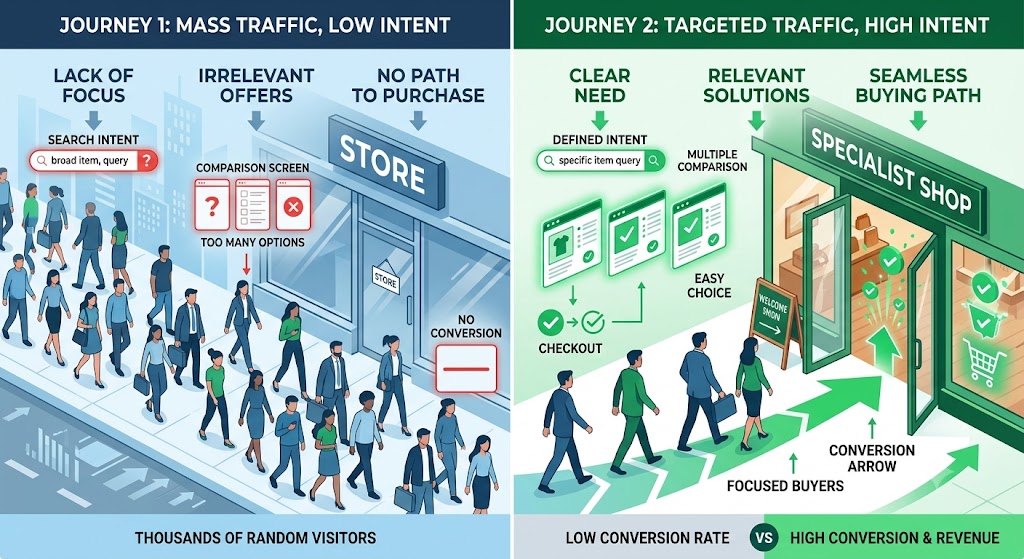
Picture two shops selling the same specialist product. One sits in a busy railway station, while the other has a small stand at an industry exhibition. The station shop sees far more people, but most are on their way somewhere else. The exhibition stand sees fewer people, yet many have arrived specifically to compare products like yours.
High-intent visitors resemble the exhibition audience. They recognise a problem, are actively considering a solution, and have a credible reason to act soon. A visitor searching for a particular product model, checking delivery to their postcode, comparing two service packages, or looking for an available local supplier is much closer to a decision than someone reading a broad introductory article.
Intent is not the same as a keyword label, of course. A commercial-sounding search can still come from a student, competitor, or curious researcher. Equally, an informational visit can become valuable later. The point is to treat intent as a testable signal rather than assuming every click has equal potential.
Pro Marketer Tips:
- Start by mapping each important landing page to the job a visitor is trying to complete. A product page should help someone assess suitability and buy. A service page should explain the outcome, scope, proof, process, and next step. A comparison page should make the trade-offs clear. If the page solves a different job from the advert, email, referral, or search result that brought the visitor there, volume will not rescue it.
- You can then group acquisition activity by likely intent. Brand searches, product-specific campaigns, remarketing audiences, partner referrals, and well-matched email clicks often deserve separate analysis from broad social reach or general-interest content. Do not declare one group better in advance. Compare what people actually do after arriving.
- Look for a sequence of useful behaviours rather than a single shallow signal. Did the visitor view an appropriate landing page, spend enough time to understand the offer, examine proof or pricing, begin the key task, and complete it? For a retailer, that might mean product view, add to basket, checkout, and purchase. For a service business, it might mean case study, pricing or process page, enquiry form, and qualified appointment.
- This is where relevance does the heavy lifting. The message that earns the click should match the page that receives it. The offer should fit the audience segment, and the next step should fit the visitor’s level of commitment. Asking a first-time reader to book an expensive consultation may be too abrupt, while making a ready buyer read three generic articles before seeing a price may be equally frustrating.
- Human-first marketing is really that simple. You are not trying to force more people through a funnel. You are helping the right people decide with less uncertainty. When the visitor’s need and the page’s purpose line up, conversion becomes a natural next step rather than a trick.
Revenue per Visitor Reveals Traffic Quality
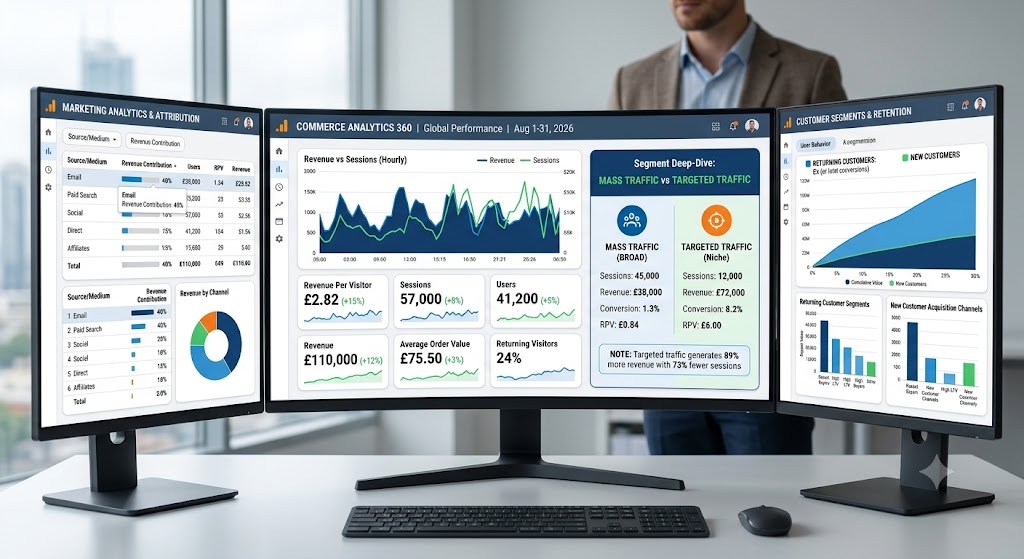
Sessions are like footfall outside a shop. Revenue per visitor tells you how much that footfall is worth. It is calculated by dividing the revenue attributed to a visitor group by the number of visitors in that group.
This metric exposes the weakness in traffic-only reporting. Imagine one campaign sends a very large audience that rarely buys, while another sends a modest audience that purchases regularly. The first campaign wins the sessions chart. The second may contribute far more money after media costs, refunds, and fulfilment are considered.
Adobe’s retail evidence gives us a real example. Its report, The ROI from Marketing to Existing Online Customers, analysed 180 retail websites representing roughly US$51 billion in annual US online sales and €18 billion in European sales. Returning purchasers produced three times the revenue per visit of shoppers with no previous purchase. One repeat purchaser generated the same revenue per visit as five shoppers in the US and seven in Europe.
Those figures should not be copied into your forecast. The report dates from 2012, concerns online retail, and uses its own definitions of shopper, returning purchaser, and repeat purchaser. Its value lies in showing how strongly audience composition can change the economics of a visit.
Your own figures are more useful. In Google Analytics 4, the traffic acquisition report can compare sessions by channel, source, medium, and campaign. It can also display engagement, key events, session key-event rate, and total revenue. Google defines total revenue as purchase, in-app purchase, subscription, and advertising revenue, less refunds, provided the relevant data has been implemented correctly.
Pro Marketer Tips:
- Create a simple source scorecard and keep the sessions column in its proper place. Review users or sessions, engaged-session rate, key-event rate, revenue, revenue per visitor, acquisition cost, and profit contribution. For a lead-based business, replace immediate revenue with qualified enquiries, attended appointments, accepted proposals, and eventual closed revenue. A cheap form submission is not valuable if sales staff cannot contact the person or the enquiry falls outside your service area.
- Do not let averages hide the useful detail. Split new and returning visitors. Compare mobile and desktop if the buying experience differs. Separate countries where pricing, delivery, or service coverage changes. Review landing pages and blog posts individually rather than assigning one conversion rate to an entire channel.
- Attribution also needs a little humility. A visitor may discover you through an article, return through an email, and finally purchase after a brand search. Last-click reporting gives the final source all the credit, even though earlier contacts helped. Use consistent campaign tagging and compare more than one attribution view before cutting a source that appears weak at the final step.
- Most importantly, use revenue per visitor as a diagnostic, not a trophy. A fall may indicate weaker targeting, an offer mismatch, a technical issue, a price change, or an influx of first-time visitors who need longer to decide. The number tells you where to investigate. It does not explain the cause by itself.
Why Higher Customer Value Offsets Lower Volume

The first purchase is often the front door, not the whole house. A customer who buys again, renews, upgrades, or refers another buyer can be worth far more than the revenue recorded during the acquisition session. That is why customer lifetime value matters when you compare traffic sources.
Customer lifetime value is the revenue or, preferably, gross profit a customer contributes over the relationship. A channel that attracts fewer first orders can still be the stronger channel if those customers buy more often, stay longer, return fewer items, or require less support.
An older but unusually transparent Bain & Company study shows the mechanism. The Value of Online Customer Loyalty drew on surveys of 522 shoppers at ten online retailers and 2,116 online shoppers across grocery, consumer electronics and appliances, and apparel. In its apparel data, the average shopper did not become profitable until the fourth purchase, which took about 12 months. Average spending by repeat apparel customers was 67 per cent higher in months 31 to 36 than in their first six months, and the tenth purchase was nearly 80 per cent larger than the first.
This is not a current cross-industry benchmark. The surveys were conducted around 1999, and the economics of apparel do not transfer neatly to software, professional services, or a local clinic. The study is useful because it demonstrates how acquisition cost, repeat purchasing, and time can alter customer profitability. You need the same analysis using your own cohort data.
Pro Marketer Tips:
- Start by grouping customers according to their first meaningful acquisition source or campaign. Then compare their performance after 30, 90, 180, and 365 days, depending on your buying cycle. Track repeat purchase rate, average order value, renewal or cancellation, refunds, support cost, and gross profit. If you only compare first-session revenue, you may undervalue the sources that attract the best long-term customers.
- GA4’s User lifetime exploration can compare an initial source, medium, or campaign with lifetime revenue and engagement. It can also show average, total, and selected percentile values. Google warns that revenue percentiles can be zero when most users are non-purchasers, so a purchaser segment may reveal more useful differences. Large properties should also note that the free version samples this exploration above one million users.
- Your customer database or commerce platform should remain the financial source of truth where possible. Analytics can lose identity across devices, browsers, consent states, and long gaps between purchases. Joining campaign information with order, subscription, or CRM records gives you a clearer view of the relationship between acquisition and customer value.
- This changes budget decisions in a practical way. A source with an expensive first sale may be perfectly healthy if it produces loyal, profitable customers. A source with a cheap first sale may be poor if customers cancel, refund, or never return. Lower volume is not a problem when the smaller cohort creates more profit and less operational drag.
When More Visits Fail to Increase Sales
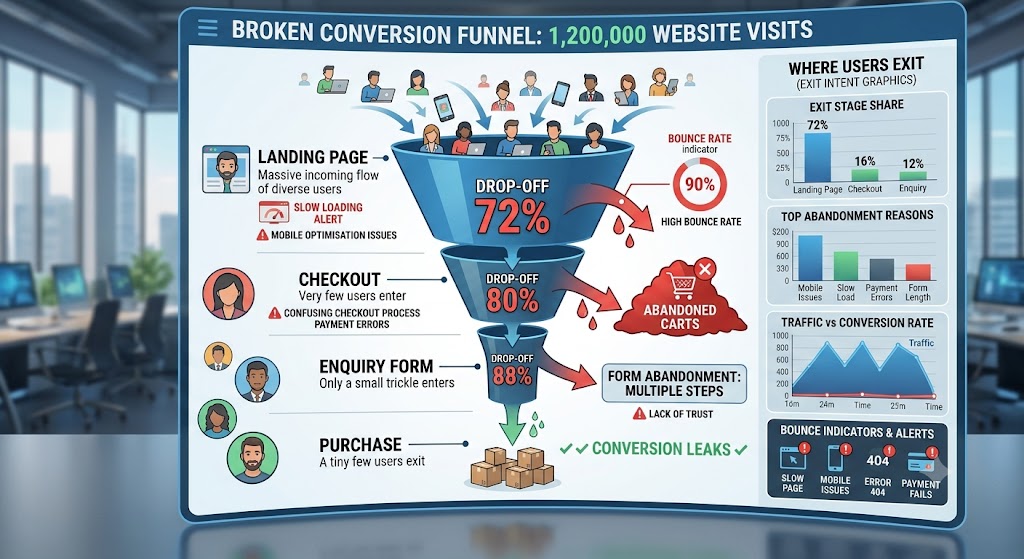
A crowded restaurant with empty plates is not having a good evening. The same applies to a website with soaring sessions and unchanged sales. More visits fail when the people, promise, page, or measurement system do not line up.
The first suspect is audience mismatch. A broad campaign may reach people outside your service area, price range, use case, or buying stage. General informational content can attract a large audience that wants an answer but has no reason to purchase. That traffic can still support awareness or future demand, but it should not be judged as if every reader were a sales opportunity.
The second suspect is message mismatch. An advert may promise one benefit while the landing page leads with another. A referral may recommend a particular service, but the link opens a generic homepage. The visitor then must work out whether the promised solution exists. Many will simply leave.
Pro Marketer Tips:
- GA4 provides a useful early warning, although not a verdict. Google defines an engaged session as one lasting longer than ten seconds, containing a key event, or including at least two page or screen views. A low engagement rate for one source or landing page can signal poor relevance, but it can also reflect broken tagging, a very fast task, or an external hand-off. Check the page and measurement setup before blaming the audience.
- Technical friction is the third suspect. Slow pages, an awkward mobile layout, unclear delivery terms, broken forms, unavailable products, surprise fees, and limited payment options can waste even excellent traffic. Review recordings or user feedback where privacy and consent allow, test the conversion path on real devices, and examine abandonment by step. Acquiring another thousand visitors before fixing a broken checkout only creates another thousand opportunities for frustration.
- You also need to separate test activity from potential customers. The open-source VisitorBoost website traffic generator on GitHub is designed to run controlled browser sessions with configurable concurrency, dwell time, page depth, devices, referrers, and internal-link behaviour. On websites you own or are authorised to test, that can help with load checks, analytics validation, and reporting QA. Those simulated sessions are not prospects, so tag or filter them and never include them in revenue or audience-quality analysis.
- Paid audience delivery is a separate proposition. VisitorBoost’s commercial page says it can supply targeted visitors for your website selected by country, niche, and device, and describes those visitors as real people rather than automated hits. These are first-party product claims, not proof that the visits will produce sales for your particular offer. Use the free demo or a small, controlled campaign, keep the traffic away from advertising inventory as the provider advises, and judge the cohort by engagement, qualified actions, revenue per visitor, refunds, and repeat behaviour.
- Run that kind of test against a clear baseline. Keep the landing page, offer, measurement, and comparison period as stable as possible. Decide in advance what success means, how long you will wait for delayed purchases, and which costs count. A session increase without an improvement in qualified behaviour is not a win.
- The practical goal is not to minimise traffic. It is to stop buying, celebrating, or reporting visits that have no credible route to value. Attract people whose needs match the offer, give them a page that respects their intent, and measure what happens beyond the click. If a smaller audience produces more revenue and stronger customers, the lower traffic number is not a setback. It is evidence that your marketing has become more precise.
As with everything in life: less is more! Make sure the traffic you attract to your website converts and gives you the brand visibility you want and need to thrive.